Tree Removal in Kitchener, Ontario
Mature maples in Stanley Park and Forest Hill, dead ash across the city, trees over the house or the service wire, and the stump afterwards. Taken down in pieces, on ropes or with a crane, by an insured crew that knows which trees Kitchener lets you cut and which ones belong to the City.
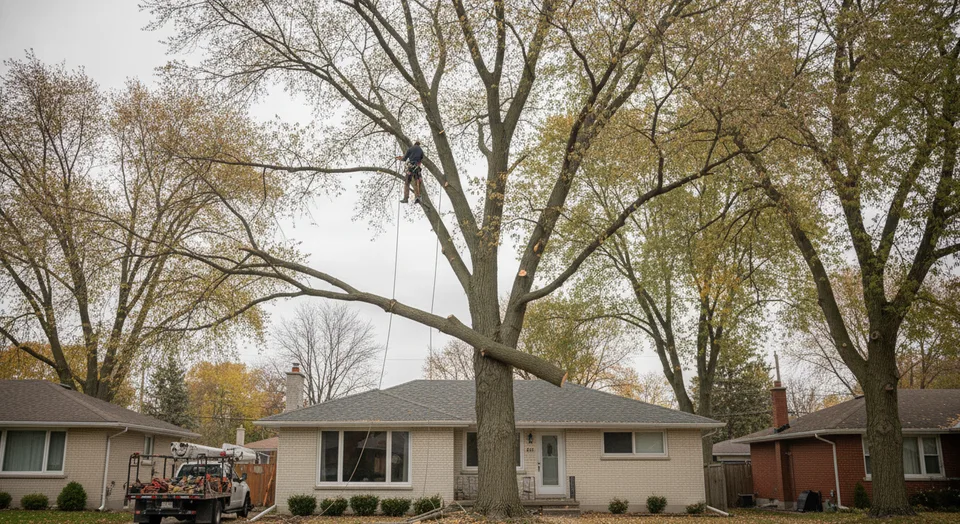
Kitchener's tree work is a tale of two housing stocks. The post-war neighbourhoods on both sides of the Conestoga Parkway, Stanley Park on the east side and Forest Hill on the west, were planted with fast-growing silver and Norway maples sixty and seventy years ago, and those trees are now 20 metres tall, 80 centimetres through, hollowing at the unions and hanging over roofs, garages and the service wire from the pole. Then there is the ash. The emerald ash borer was first confirmed in this region in the woodlands either side of the 401 at Homer Watson, and a decade on there is scarcely a living untreated ash left in the city: what remains are standing dead trees in back yards through Doon, Pioneer Park, Country Hills and Chicopee that get more brittle every season and come apart badly when they finally fail. A lot of Kitchener owners assume they need a permit to cut any of this down. Most do not. The City's private tree by-law only reaches lots larger than one acre, so an ordinary residential property can take down its own tree, while a boulevard tree in front of the same house is the City's and cannot be touched. Which is which, how the tree comes down without landing on anything, where the wood goes and what the stump needs are all settled on the site visit, before there is a number on paper.
Tree Work We Take On in Kitchener
Removal of large and hazardous trees including crane-assisted dismantles, stump grinding, pruning and crown reduction, storm and emergency work, hedge and brush clearing, and dead ash removal.
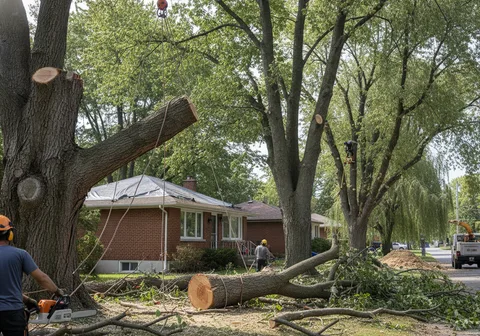
Large & Hazard Tree Removal
Big trees over houses, garages and wires, hollow or split trunks, and the crane-assisted dismantles where there is no room to drop anything, done in sections by a roped-in climber or from a bucket.
Learn more →
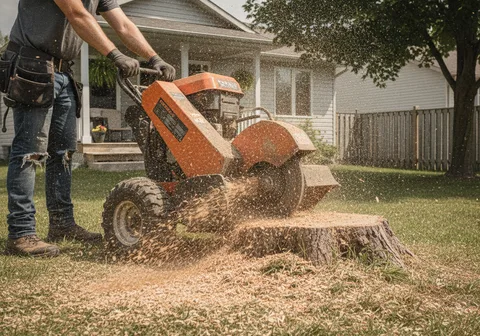
Stump Grinding
Stumps and surface roots ground well below grade so the spot can be sodded, planted or fenced over, with buried utilities located first and a plan for the grindings.
Learn more →
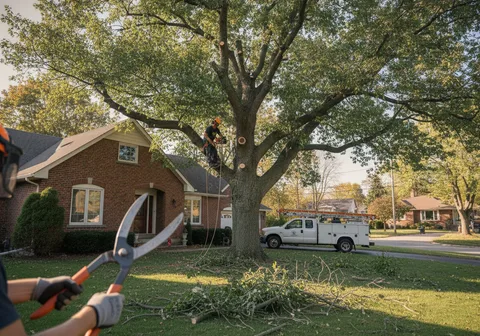
Pruning & Crown Reduction
Deadwood out, limbs lifted off the roof and the wire, weight taken off over-extended leaders and proper crown reduction on the mature maples, so a good tree stays rather than comes down.
Learn more →
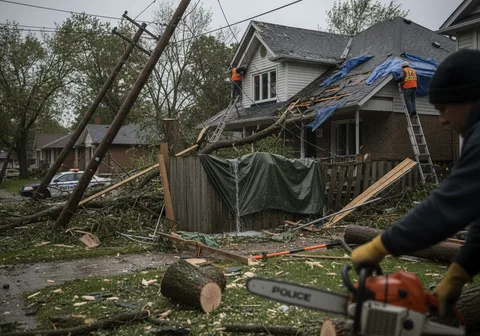
Storm Damage & Emergency Work
Trees on houses, garages and fences, hangers over the yard, split unions and blocked drives after ice storms, wind and heavy wet snow, with priority response when a tree is on a structure or a line.
Learn more →
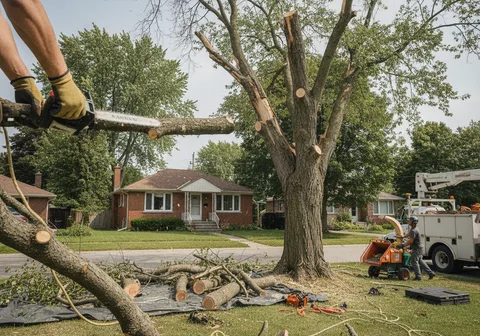
Ash Tree (EAB) Removal
Dead and declining ash killed by the emerald ash borer, dismantled before they come apart on their own, with the wood chipped and disposed of inside the CFIA regulated area as the rules require.
Learn more →
Tree Removal in Kitchener: Whose Tree, Which Rules, Where the Wood Goes
The private tree by-law, and why most Kitchener homeowners are outside it. Kitchener does regulate trees on private land, but the reach is narrower than people expect. The City's tree protection page says a tree conservation permit may be needed to remove a tree from a property larger than 0.405 hectares, which is one acre, and the by-law covers trees over 10 centimetres in diameter at chest height on those lots. A standard subdivision lot in Stanley Park, Forest Hill or Doon South is a fraction of an acre, so no permit applies and the owner decides. Even on a lot over an acre there are exemptions that cover most real situations: trees under 10 cm, trees within 5 metres (16.4 feet) of an occupied building, dead, diseased or hazardous trees certified as such by someone the director of planning has approved, and storm-damaged trees removed for public safety. Where a permit is needed it goes through planning@kitchener.ca with a plan or survey and the fee. One caution: the City has been consulting on changes to this by-law through 2025 and 2026 and a report to Council is pending, so the acre threshold is what applies today and gets re-checked at the time of the quote rather than assumed.
Boulevard trees are the City's. Do not let anyone cut one for you. The tree between the sidewalk and the curb, or in the road allowance where there is no sidewalk, belongs to the City of Kitchener regardless of who planted it or who has been raking its leaves for thirty years. The Public Tree Bylaw was rewritten in June 2025 and it is strict: no cutting, pruning or root damage, mandatory City approval and protection measures for any work within 6.09 metres (20 feet) of a city tree, protection zones scaled to trunk size, and fines up to $10,000 plus restoration or compensation for unauthorized damage. If a boulevard tree is dead, dropping limbs or lifting the sidewalk, the route is 519-741-2345 or trees@kitchener.ca, and the City's forestry crew deals with it. What that means for a private removal is that a street tree within 20 feet of where a crane sets up or a trunk section comes down is part of the plan, and the City is asked first. A contractor who offers to take a boulevard tree down quietly is offering you the fine.
Ash trees: what the borer did to Kitchener, and where the wood can go. Emerald ash borer was first confirmed in Waterloo Region in woodlands on either side of Highway 401 at Homer Watson Boulevard, on the Kitchener and Cambridge sides, and it has since killed the great majority of untreated ash across the city. A dead ash is not an ordinary dead tree. The wood dries and cracks fast, the bark sloughs off, limbs shear at the trunk without warning, and within two or three years of death a climber cannot safely be in it, which pushes the job toward a bucket truck or a crane and puts the price up. The other thing that is different about ash is the paperwork on the wood. The Canadian Food Inspection Agency lists the Regional Municipality of Waterloo as an EAB regulated area, and ash logs, branches, bark and firewood cannot be moved out of the regulated area without the CFIA's consent. In practice that means the wood is chipped and disposed of locally or left on site as firewood for you, and never trailered to a cottage. Owners with a surviving ash that is still mostly green have a real choice between injection treatment and removal, and that is worth an honest look before anyone fires up a saw.
Woodlots and the Region's by-law. On the edges of the city, out toward Breslau, along the Grand River corridor and on the larger properties in the south end, some trees stand in a woodland rather than a yard, and a different law applies. The Region of Waterloo's Woodland Conservation By-law 08-026 regulates cutting in woodlands of one hectare or more in contiguous size that meet the Forestry Act density tests (for example 250 trees over 20 cm per hectare), and the woodland boundary can run straight across property lines. A permit is required before cutting starts, there are several permit types depending on what is being done, and the Regional Forester (519-580-0296) is the person to ask. Taking a hazard tree out of the edge of a woodlot is normally a conversation rather than a problem, but clearing a strip of bush to open up a view is the kind of job the Region will want to hear about first.
The service wire, the pole, and Enova. A silver maple over the drive is usually also a silver maple over the wire from the pole to the house, and that changes the job. Enova Power, the distribution utility for Kitchener, says people and equipment must stay at least three metres from a power line, that keeping the service wire on your property clear of trees is the owner's responsibility, and that a tree hazardous to an overhead line can be reported through its Forestry Service Call Request form or at 226-896-2200 so Enova can inspect it. For a removal that cannot keep that clearance, the sequence is to involve the utility before the day, not to send a climber up with a pole saw and hope. Near the Grand River and Schneider Creek, some properties also sit inside a Grand River Conservation Authority regulated area under O. Reg. 41/24. Felling a tree is not itself a listed activity, but grading the bank afterwards, placing or removing fill, or driving a crane across a slope above a watercourse can be, and the GRCA's Map Your Property tool is where to check before the job is planned.
Serving Kitchener & Surrounding Areas
Private tree permits in Kitchener apply to lots larger than 0.405 ha (one acre) and are described on the City of Kitchener tree protection page, which also sets out the June 2025 Public Tree Bylaw rules for city-owned trees (519-741-2345, trees@kitchener.ca). The City's ongoing review of the private tree by-law is at Engage WR. Woodlands of one hectare or more fall under the Region of Waterloo Woodland Conservation By-law 08-026. Waterloo Region is an emerald ash borer regulated area under the Canadian Food Inspection Agency, so ash wood and ash firewood may not leave the region without CFIA consent. Clearance from power lines and reporting of hazardous trees near lines follow Enova Power's tree trimming guidance. Properties in a regulated area may need a permit from the Grand River Conservation Authority under O. Reg. 41/24 for grading, fill or watercourse alteration; check an address with GRCA's Map Your Property tool. Oak pruning timing follows Ontario's oak wilt guidance.
Frequently Asked Questions
Do I need a permit to remove a tree on my property in Kitchener?
On a normal residential lot, no. Kitchener's private tree by-law applies to properties larger than 0.405 hectares, one acre, and most city lots are well under that. On a lot over an acre a tree conservation permit may be needed for trees over 10 cm diameter, with exemptions for dead, diseased or certified hazardous trees, trees within 5 metres of an occupied building, and storm damage. The City is reviewing the by-law, so we confirm the current rule for your address at the quote.
The tree is on the boulevard in front of my house. Can you remove it?
No, and neither can anyone else without the City's approval. Boulevard and road-allowance trees belong to the City of Kitchener, the Public Tree Bylaw prohibits cutting or damaging them, and any work within 6.09 metres (20 feet) of one needs approval and protection measures. Report a dead or dangerous city tree to 519-741-2345 or trees@kitchener.ca. If your private tree stands within 20 feet of a city tree, that is planned around and the City is involved.
My ash tree is dead. Is it urgent?
Reasonably, yes. Ash killed by emerald ash borer goes brittle quickly, sheds large limbs without warning and becomes unsafe to climb within a few years, at which point it needs a bucket or a crane and costs more. If it stands over the house, a neighbour's property or a sidewalk, it should come down this season rather than next. The wood stays in Waterloo Region because of the CFIA regulated area.
How much does tree removal cost in Kitchener?
It depends on the size of the tree, what is underneath it, whether a crane or bucket truck can get to it, and whether the wood can be dropped or has to be rigged down piece by piece. A small open-yard tree and a 70-year-old maple leaning over a Stanley Park bungalow are not the same job. Planning ranges are on the cost page; the real number follows a look at the tree.
Can you take a tree down without damaging the lawn or the garden?
Usually, by rigging sections down on ropes instead of dropping them, laying plywood where equipment travels, and lifting over a house with a crane where the back yard cannot be reached. There is always some impact from a large removal; the quote says what to expect and what is protected.
What happens to the wood and the stump?
Brush is chipped on site and hauled, or the chips are left for your beds if you want them. Logs can be bucked into firewood lengths for you or removed. Ash wood does not leave the region. The stump is a separate line on the quote: grinding below grade so you can re-sod or replant, or leaving it if you prefer.
Do you work in winter?
Yes, and for large removals it is often the better season. Frozen ground carries a crane or a chipper without rutting the lawn, the beds are dormant, and the leaves are off so the structure of the tree is visible. Storm work happens whenever the storm does.
Ready to Get Started?
Call 289-512-9143 or send the form for a written quote for tree removal in Kitchener.